
Google Maps Ranking Factors in 2026: What’s Changed and What’s Still Quietly Driving Results
Google maps seo services
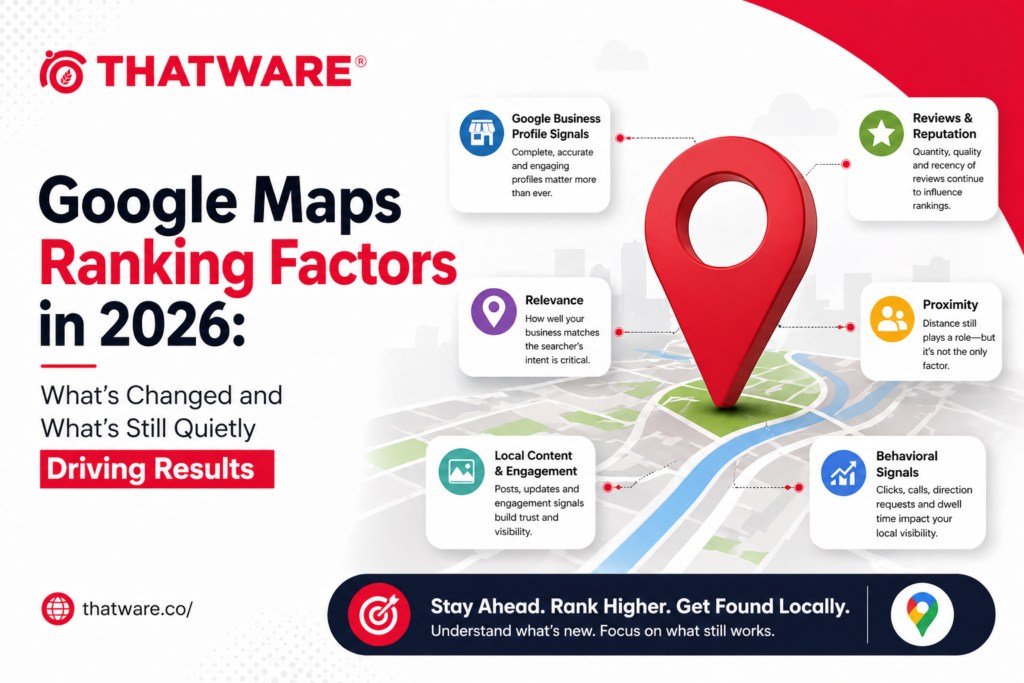
The local pack has been one of the more stable parts of search, in the sense that the broad ranking factors have been known for years and haven’t been fundamentally replaced. Relevance, distance, and prominence. These three pillars have governed local pack ranking since Google Maps became the dominant local search interface.
What has changed is the weighting of specific signals within those pillars, the introduction of new ranking inputs as Google’s local search product has evolved, and the growing influence of the AI-mediated search layer on how local businesses appear in search. Understanding what’s actually driving results in 2026 requires updating the conventional local SEO wisdom with what the current data suggests.
What’s Changed in the Last Two Years
Review signals have become more nuanced in how they’re weighted. It’s not just total review count and average rating anymore. Review recency carries more weight than it used to, meaning a business with 500 reviews where 400 were posted two years ago is being evaluated differently from a business with 300 reviews where 200 are from the past twelve months. Review velocity, the rate at which new reviews are arriving, has become a more explicit ranking input.
Review content has also become a more significant factor. Google’s ability to process the text of reviews and extract topic-specific quality signals has improved. A restaurant with reviews that frequently mention specific dishes and specific qualities of the experience is generating richer quality signals than one with generic “great place, highly recommend” reviews. Businesses that encourage specific, detailed reviews from customers are building richer review profiles than those that simply ask for any review.
AI Overview integration with local search has introduced a new visibility layer. For many local service queries, Google now shows AI-generated summaries that synthesize information about local businesses and services. Appearing well in these summaries requires both strong local pack ranking and the kind of structured, specific business information that AI systems can extract and use.
Google maps seo services that are current with these changes are building review strategies that emphasize recency and specificity alongside overall volume.
What’s Still Quietly Driving Results
Several factors that were important three years ago remain important today and sometimes get underweighted in current local SEO conversation because they’ve been discussed for so long.
Google Business Profile completeness is still one of the highest-ROI local SEO activities for most businesses. A fully complete profile, with all relevant categories selected, all attributes checked, updated hours including holiday schedules, recent photos covering all relevant aspects of the business, and regular post activity, signals active and reliable business information in ways that incomplete profiles don’t.
NAP consistency across the web is less discussed than it was a few years ago, but it remains a foundational local ranking factor. Inconsistent name, address, and phone number information across directories, review sites, and other web mentions creates conflicting signals that suppress confidence in the business’s entity data. Periodic citation audits to identify and correct inconsistencies continue to produce ranking improvements for businesses that haven’t done this work recently.
Website-GBP alignment is underappreciated. The correlation between the information on a business’s website and its Google Business Profile affects how confidently Google can validate the business’s claims. Businesses whose website and GBP are tightly aligned in terms of service descriptions, geographic service areas, and business information tend to rank more consistently than those with significant discrepancies.
The Local Content Opportunity
Gmb optimization services that are forward-looking are building local content strategies alongside GBP optimization, because local content and local pack rankings increasingly reinforce each other.
Locally relevant content on the business’s website, coverage of local events, community involvement, location-specific service pages, local resource guides relevant to the business’s category, builds the local topical signals that support GBP ranking while also driving organic traffic for local informational queries.
This content dimension is where many local businesses are underinvesting. Most local SEO attention goes to GBP optimization and review management, both of which are important. The content layer that builds local topical authority is less commonly developed but increasingly relevant as Google’s local search evaluation becomes more sophisticated.
Mobile Behavior and Its Ranking Implications
Local search is overwhelmingly mobile, and this affects which signals matter most. Click-to-call rates, direction requests, and Google Business Profile interactions from mobile users are engagement signals that feed into local prominence evaluation. Businesses that generate high interaction rates from their local pack listings are building stronger prominence signals than businesses that appear in the pack but generate low engagement.
Encouraging customers to interact with the business through Google Maps, leaving reviews, answering Q&A sections, adding photos, generates the kind of sustained profile activity that signals an actively engaged business to Google’s local ranking systems.
The businesses that are winning in local search in 2026 are the ones treating their Google Business Profile as a living platform rather than a directory listing that gets set up once and left alone. Regular updates, active review response, fresh photos, ongoing Q&A engagement: these sustained activities compound into prominence signals that static profiles don’t generate.
The fundamentals haven’t changed. The sophistication of how those fundamentals are executed is what separates the businesses at the top of the local pack from those competing for position.